Author: Rachel Sykes

  • The Dos and Don’ts: Common SEO Mistakes and How to Dodge Them

    The Dos and Don’ts: Common SEO Mistakes and How to Dodge Them

    In the ever-evolving landscape of digital marketing, mastering Search Engine Optimisation (SEO) is crucial for enhancing your online presence and driving organic traffic to your website. However, it’s easy to stumble upon pitfalls that can hinder your website’s visibility and rankings on search engine results pages (SERPs). In this guide, we’ll delve into the dos and don’ts of SEO. Shedding light on common mistakes to avoid and providing actionable insights on how to navigate through them.

    Understanding the Importance of SEO

    Before we dive into the dos and don’ts, let’s reiterate why SEO is vital for your online success. SEO serves as the cornerstone of digital marketing. Empowering businesses to improve their website’s visibility, attract targeted traffic, and ultimately boost conversions and revenue. By aligning your website’s content, structure, and optimisation techniques with search engine algorithms, you can enhance your chances of ranking higher on SERPs and outperforming competitors in your niche.

    The Dos: Proactive Strategies for SEO Success

    1. Conduct Thorough Keyword Research

    SEO Mistakes to Avoid: Neglecting keyword research or targeting overly competitive keywords can diminish your website’s visibility and make it challenging to rank effectively.

    Solution: Invest time in comprehensive keyword research to identify relevant, high-volume keywords that align with your content and target audience. Utilise keyword research tools such as Google Keyword Planner, SEMrush, or Ahrefs. These uncover valuable insights into search trends, competition levels, and user intent. SEO providers such as ourselves use specialised software to conduct in-depth keyword research. This ensures the content is associated with the right kind of searches.

    2. Optimise On-Page Elements

    SEO Mistakes to Avoid: Overlooking on-page optimisation factors such as meta titles, meta descriptions, headers, and image alt text can undermine your website’s SEO potential.

    Solution: Ensure each page of your website is optimised with unique, descriptive meta titles and compelling meta descriptions that entice users to click. Incorporate relevant keywords naturally into headers and body content while maintaining readability and user experience.

    3. Prioritise Quality Content Creation

    SEO Mistakes to Avoid: Publishing thin, low-quality content or duplicating content across multiple pages can lead to penalties from search engines and diminish your website’s credibility.

    Solution: Focus on creating high-quality, valuable content that resonates with your audience’s interests and addresses their pain points. Strive for originality, relevance, and depth in your content, and aim to provide unique insights or solutions that set your website apart from competitors.

    4. Build High-Quality Backlinks

    SEO Mistakes to Avoid: Pursuing spammy or low-quality backlinks from irrelevant websites can harm your website’s authority and reputation in the eyes of search engines.

    Solution: Adopt a strategic approach to link building by seeking opportunities to earn backlinks from reputable, authoritative websites within your industry. Focus on building natural, organic backlinks through content promotion, guest blogging, influencer outreach, and participation in relevant online communities.

    Conclusion

    By following these SEO tips, you can steer clear of common pitfalls. And position your website for long-term success in the competitive digital landscape. Remember to prioritise user experience, relevance, and quality across all aspects of your SEO strategy. Be sure to continuously adapt to evolving search engine algorithms and industry trends. With a proactive approach to SEO optimisation, you can elevate your website’s visibility, attract targeted traffic, and achieve sustainable growth in your online endeavours.

    Ready to take your SEO to the next level?

    Here at Social Plus, our team is on hand to provide industry-leading support for your SEO. From Keyword research to content creation and Mobile optimisation.

    With our research, Industry experience, and Specialist Software, we can help kickstart your SEO  journey.

    Click here to find out more!

    Additionally, why not take a look at our socials to see what we’re about –  Facebook, Instagram, and LinkedIn.
  • The Power of PPC

    The Power of PPC

    Boost Your Business with Targeted Advertising

    What is Targeted Advertising with PPC?

    Targeted Advertising or Audience targeting refers to the method of separating consumers into different groups. These can be divided by things such as their interests, hobbies, location, income, marital status and many more. Knowing who your audience is can be a huge help when looking to start PPC campaigns. It’s important to align your campaign strategy with the audience’s preferences and interests to see the best results.

    The kind of data you would want to include would be:

    • Age
    • Gender
    • Location
    • Interests
    • Income

    Targeted Advertising benefits greatly from a wealth of data on your chosen audience just remember to keep it relevant! A key thing to remember when choosing your data and keywords is to keep it specific. You want to use long-tail keywords and specific targeting to generate the most traffic possible to your site! Targeted Advertising can show your ads directly to the people most likely to be interested in your products or services!

    How does Audience Targeting for PPC work?

     In short Audience Targeting uses the data provided to segment their audience members into groups and target them with content.

    PPC Audience Targeting uses both First-party and Third-party data. First-party data includes data captured by the business itself through cookies. First-party data usually provides insight into the customer’s interests and behaviours. Whereas third-party data includes information collected from an outside source such as geographic location.

    Through the combined use of first and third-party data, we can segment audience members into groups and target them directly with content relevant to their key characteristics.

    What are the benefits of Targeted Advertising with PPC?

    According to PPC stats, Paid advertisements redirect 65% of traffic while organic search results only get 35% of the clicks. This statistic shows the power of Targeted Advertising with PPC with a significantly higher conversion rate. It has been shown that PPC generates twice the number of visitors when compared to SEO. Paid advertisements have also been shown to generate a 200% Return on Investment.

    Using targeted advertising helps save you time and resources for bigger tasks. With PPC you have the opportunity to focus your ads to make your impressions count and convert browsers into customers.

    Targeted advertising can lead to improved customer loyalty and free word-of-mouth promotion. By targeting the customer’s needs and providing them with the right service you are much more likely to retain them long term and create both repeat business and advocacy.

    So, you’ve decided PPC is for you, what next?

    Once you’ve decided PPC is for you it’s imperative to make sure it’s set up correctly from the get-go and managed carefully going forward. By monitoring your campaign’s success, you are able to see which sections of your campaign and which keywords are performing the best and worst. You can constantly evolve your PPC campaign, slightly changing keywords and adding negative keywords to stay at peak performance. By performing this regular maintenance and making changes you can boost the already impressive performance of PPC campaigns.

    Need help with PPC and Targeted Advertising?

    Here at Social+, we provide in-depth Audience Targeting and PPC services.

    PPC is a great way to reach people who are actively looking for products and services like yours. This leads to higher conversion rates and increased sales and can even help increase the quality of customer relationships leading to loyalty and advocacy for your brand.

    We cater to businesses from a range of industries, and we tailor your package to your business needs.

    Visit our website for more information!

    Additionally, why not take a look at our socials to see what we’re about – Facebook, Instagram, and LinkedIn.
  • LinkedIn Algorithm Changes –

    LinkedIn Algorithm Changes –

    What’s new and how does it affect you?

    LinkedIn Algorithm Changes – It has made some pretty big changes to its algorithm and how it prioritises posts and content for its users. This information comes via Jason Feifer of Entrepreneur, who recently spoke to the LinkedIn team about their updates. In this blog, we cover everything you need to know to stay relevant to the new changes.

    There are two main changes affecting the reach of posts on LinkedIn:

    1. If you post on LinkedIn, it is now more likely that your followers will see your post.

    This change comes after users preferred content from people they “know and care about”, saying they found content from their own connections more valuable. Already, LinkedIn has seen a 10% increase in people viewing posts from people they know. If you want to prioritise your impressions, now would be the time to do it!

    2. Posts that share “Knowledge and Advice” are now prioritised throughout the platform.

    This change goes hand in hand with the first – Posts sharing “knowledge and advice” will now be a primary way to reach people who are not current connections. LinkedIn’s system will now evaluate whether a post contains knowledge and advice, categorise it, and show it to other users whom it deems likely to find it relevant and useful. LinkedIn aims to provide greater value to help its users feel “more productive and successful”. With this shift to value-based algorithm changes it is more important than ever to produce high-quality social media posts.

    But how does the LinkedIn algorithm identify “Knowledge and Advice”?

    While they haven’t told us every metric they use to classify posts, they have given us a few. From everything we know, it looks like LinkedIn is making a shift to prioritising quality and relevant posts and content to bring more value to its users. A few of the new metrics used to identify posts providing “knowledge and value” include:

    The post speaks to a distinct audience – The system will look at posts and ask, “Who is this relevant to”. For example, a personal birthday post would most likely only go to close connections. While a post on B2B advertising would be visible in that sector regardless of connection status. Following this, the post’s success depends on whether it provides good advice and value to other users.

    The author is writing in their core subject area – Now when posting on LinkedIn, the platform isn’t just evaluating the value of your post. It’s now also evaluating you, and the value you hold in your core subject area. Engaging in your core subject area builds a trust factor and lets LinkedIn you are relevant in that category. Your previous post’s success in a given category will increase your visibility too. There has been an overall shift to providing higher quality and relevant content to its users.

    The post has “meaningful comments” – In the past LinkedIn would amplify posts with a lot of comments. As a result, some users banded together to create “engagement groups” where they agree to like and comment on posts. LinkedIn wanted to stop this and now random comments of “great” or “so true” will not hold value. Relevant comments to the content itself and responses from the original poster will have significantly more value. The algorithm will see these exchanges as a “conversation” that other people may find value in and boost this instead.

    Need a little help with the LinkedIn Algorithm Changes or your company’s Social Media?

    Here at Social+, we understand the world of social media is fast-paced and constantly changing.

    We also know how time-consuming and complicated it can be to keep on top of fast-paced changes.

    That’s where we come in. We’re on hand ready to assist you with all your digital marketing and website needs.

    We cover everything from assisting with social posts to fully managed social packages.

    We cater to businesses of all sizes and industries, and we tailor your package to your business needs.

    Why not look at our socials to see what we’re about – Facebook, Instagram, and LinkedIn.
  • The role Social Media has played in Women’s Equality

    The role Social Media has played in Women’s Equality

    Today, 8th March 2023, we celebrate International Women’s Day! Here at Social+, we join women worldwide and use today to recognise women’s accomplishments, raise awareness about gender disparities & discrimination, and promote global support for women! In this blog, we look at 3 ways social media has been a powerful tool in promoting equality for women.

    Social media and its role in gender equality

    Social media platforms have become an integral part of invoking change within our society. As social platforms continue to consume our everyday lives, their part to play in encouraging change is ever-increasing. Social media has been a game-changer in the world of activism and promoting equality. Women have been at the forefront of using it to spread their message. In this blog, we explore three ways women have used social media to promote equality.

    Hashtags and Viral Campaigns

    Hashtags are a powerful tool for raising awareness and creating a sense of community around a particular issue. Women have used hashtags to draw attention to issues like gender-based violence, workplace discrimination, and reproductive rights. One example of a successful viral campaign was the #MeToo movement. This movement encouraged women to share their experiences of sexual harassment and assault. The campaign went viral, with millions of women sharing their stories on social media. This created a powerful sense of solidarity and raised awareness about the pervasiveness of sexual violence. Many celebrities got involved in the movement and used the hashtag, including the likes of Jennifer Lawrence and Gwyneth Paltrow.

    Amplifying Voices and Diverse Perspectives

    Social media has given women a platform to amplify their voices and share their perspectives. Women from all walks of life have used platforms like Twitter, Instagram, and TikTok to share their stories and experiences. Giving visibility to issues that may have previously been overlooked. For example, women of colour have used social media to highlight issues of intersectionality and draw attention to the unique challenges they face. Social media has also enabled women to connect with others who share similar experiences and create supportive communities. Without social media, many women would not have been able to connect with those facing similar issues from all walks of life from every corner of the globe. Moreover, without social media, many issues faced by women may have never received the publicity they have. Allowing them to present the challenges they face at the forefront of people’s minds.

    Holding Institutions Accountable

    Social media has given women the power to hold institutions accountable for their actions. Women have used social media to call out instances of sexism, misogyny, and discrimination, often leading to changes in policies or public opinion. For example, the #NotBuyingIt campaign called out sexist advertising, leading to changes in the way brands marketed their products. Social media has also been a powerful tool for holding individuals accountable, with women sharing their experiences of workplace harassment or abuse and calling for justice. Social media platforms allow others to join forces and support such movements. Making women a force to be reckoned with.

    International Women’s Day

    In conclusion, social media has been a powerful tool for women to promote equality, from viral campaigns to amplifying diverse voices and holding institutions accountable. As we continue to navigate the complexities of social media, it’s important to recognise the impact it can have on promoting equality and supporting marginalised communities. Here at Social+, we use today to recognise the positive impact social media has had on the equality of women. Our team here at Social+ is full of talented and powerful women who we are extremely proud of.

    Happy International Women’s Day!

  • Endless scrolling could come to a halt with TikTok’s new time break feature

    Endless scrolling could come to a halt with TikTok’s new time break feature

    We’re sure that every TikTok user has fallen into the trap of endless scrolling at some point. The app is now launching a solution to help solve this problem and reduce your screen time.

    The video-sharing social media platform has announced the introduction of a new time break feature. This is targeted towards the ‘digital-well-being’ of its users.

    How it works

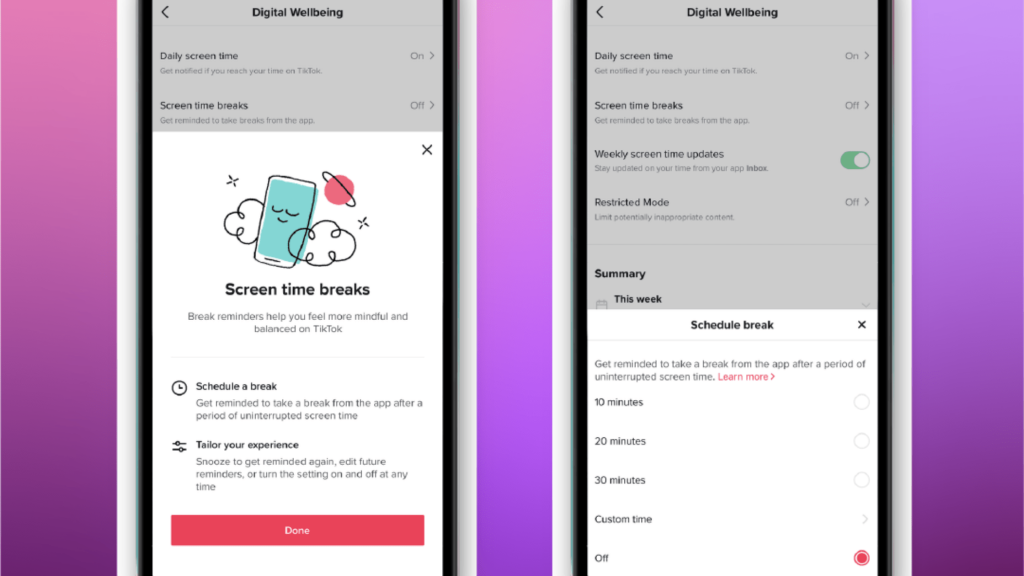
    The screen break feature allows you to control the amount of time you spend on the app in a single session.

    tiktok new feature
    Photo: TikTok

    Featuring custom set time breaks, users will receive a prompt after a certain amount of uninterrupted screen time.

    This new feature is great for those wishing to reduce their screen time in general or for those wishing to switch off before bed.

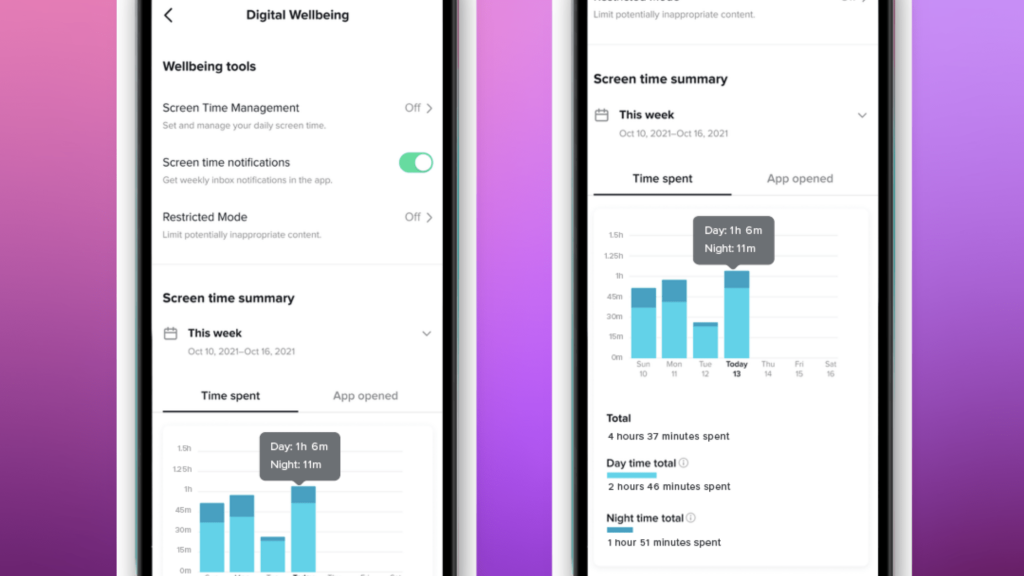
    Additionally, users will gain access to a new screen time dashboard. This allows you to view the amount of time you spend on the app each week.

    Breaking down usage into two categories, the dashboard splits the time spent on TikTok into daytime and night-time usage.

    tiktok new feature
    Photo: TikTok

    You can also request a prompt from TikTok to remind you to review your dashboard each week. We assume this will be a helpful feature. We all know it’s easy to forget in the sea of things we need to remember.

    How the TikTok feature is tailored to a younger audience

    It was announced that TikTok will also be introducing weekly digital well-being prompts for its younger audience.

    Someone between the age of 13 and 17 will be reminded of the tool after using the app for more than 100 minutes in a single day.

    Carolyn Bunting MBE, CEO, Internet Matters, commented: “The research showed that younger users would welcome the introduction of built-in features and settings that prompt them to both think critically about the time that they are spending online, but also encourage them to use settings to actively manage the time they spent on the app.

    “It is important that they feel in control of their online experiences and are helped to make considered choices. We look forward to TikTok developing further features that will put children’s wellbeing at the heart of their design choices.”

    Keep an eye out in our newsroom for more social updates.

  • Have you heard about the new Meta updates?

    Have you heard about the new Meta updates?

    As previously discussed, platforms such as Facebook and Instagram (now known as Meta) are updating and changing all of the time.

    And once again, the Social+ team are here to help breakdown the updates for you. Explaining what they mean for your business.

    The Meta-verse can be exhausting for business owners, so we’ll get right into it!

    Firstly, Meta have decided to tackle Facebook groups.

    Facebook groups are an excellent way to build a strong community for your customers. Ultimately resulting in loyalty and support, with a knock-on-effect on your pages reach and engagement.

    Meta have enhanced the sense of community, by allowing admins to determine specific colour themes, fonts and post backgrounds.

    As well as unique reaction emojis tailored to your group.

    When a user enters your group, they can be sent personalised welcome messages automatically.

    Important messages that you want to be seen by all members, for example Christmas opening hours or sale dates, can be pinned at the top of the group to increase visibility.

    Facebook are also in the process of testing new features for 2022.

    These features include the ability to create sub-groups, set up shops for group merchandise, setting up paid sub-groups for subscriptions and exclusive content, and the ability to create community fundraisers.

    Facebook are also looking into testing community chats on Messenger and recurring events to allow easier planning for groups.

    Meta have also been updating Instagram this month.

    All users can now add links to their stories, regardless of the number of followers or blogger-status.

    Users can also now delete singular images from carousel posts.

    For now, that is all the Meta updates explained. However we have no doubt that we will be back early next year explaining more!

    If social media management is something you struggle with why not give us a call on 0191 466 1550. We would be more than happy to discuss how Social+ can help you.

  • The Ultimate Guide for tackling the Facebook Algorithm E-Book

    The Ultimate Guide for tackling the Facebook Algorithm E-Book

    The Facebook algorithm decides which posts we see, and in what order we see them. Read our free eBook to find out more. Click the below image to download the eBook.

  • How to make Instagram a more positive place

    How to make Instagram a more positive place

    Headlines this week have discussed how Facebook are aware of how Instagram can have harmful effects on young girls.

    The media have stated that Facebook conducted an internal study. According to The Guardian, the results of this study shown that 32% of teen girls said that “when they felt bad about their bodies, Instagram made them feel worse.”

    Instagram is a photo and video sharing platform which has evolved into a space where users can be paid for posting content that is affiliated with brands.

    This has resulted into the rise of Influencers, and with that comes the pressure of looking somewhat ‘perfect’ on social media.

    Influencers may feel pressured to be seen as flawless, and therefore may edit their pictures or post images with filters on.

    Although the use of filters and editing apps may be innocent, this can set unrealistic expectations for young girls using the app.

    So, it is understandable that the use of Instagram may negatively affect young girls when they are questioning their self-worth.

    However, we believe that if Instagram is used mindfully, it can be a positive experience for users including young girls.

    The most obvious first step in doing so, is to follow accounts that make you feel good! This could be accounts that post advice and reminders such as @wearefeelgoodclub or thought-provoking accounts such as @allontheboard.

    Influencers such as @georgie.clarke and @_nelly_london are known for their authentic and honest content, posting un-posed images, stretchmarks and more. Their goal is to normalise normal bodies on social media, and we are here for it!

    The flip side of this advice is that this may also mean that you will have to unfollow accounts that don’t make you feel good. If you look at images of someone and then have negative thoughts about yourself afterwards – unfollow! Life is too short, and you need to learn to accept and love the skin that you are in.

    Step two is to remember that likes are simply just a number. A number on the bottom of yours or another user’s photo does not dictate your worth. Instagram are also in the process of making this feature optional on the app, with the aim of ‘depressurising people’s experience’.

    Step three – build your community – follow and interact with relatable accounts that remind you of yourself. Create a space where you are connected with people who support each other online.

    And remember, you only see the best parts of people’s lives. You might see users going out for cocktails and shopping in Harrods, but you don’t see them being late for work and spilling coffee down their white top at the beginning of the day! Nobody’s life is perfect and try not to let social media convince you that it is.

    Having said that, Instagram is a great place for brand awareness and promotion. Using Instagram effectively can boost your business’ profitability and reputation.

    This is something that Social+ can help you with! We offer packages that include social media management, web design, email marketing and more.

    If this is something that would benefit your business, get in touch today for a free consultation on 0191 450 1066 or email us on hello@social-plus.media.

  • LinkedIn for Business: Is your Business Connected?

    LinkedIn for Business: Is your Business Connected?

    We already know, that being on all social media platforms is not essential. From LinkedIn to Tiktok, you need to decide which platforms are relevant for your business.

    Depending on your industry, target audience and goals. You may be selective when it comes to your online presence.

    A strong online presence allows you to communicate with your consumers and show the personality of your brand.

    By defining your brand voice, you are able to dictate which platforms are best for your business.

    However, LinkedIn is often overlooked. LinkedIn is the world’s largest professional network on the internet.

    It allows you to job search, find candidates and network with other businesses and their employees.

    LinkedIn also allows you to start important conversations with a community of professionals, discussing topics that are relevant to your brand.

    Networking is an integral cog that is required for the growth and success of a business.

    By connecting your personal profile to your LinkedIn page, you can navigate around the platform with two touchpoints.

    And the best part of online networking is that your network can expand both, nationally and internationally, without travel expenses and time consumption.

    You can develop genuine connections that will benefit your business from the comfort of your own home.

    LinkedIn isn’t just for the CEOs of national law firms – it’s for students, interior designers, journalists, property developers. Any profession, you name it, and you can be on LinkedIn.

    A strong connection also results in higher engagement, you are slowly building a supportive community who want to see you succeed.

    By creating genuine connections, you are able to offer your services in an approachable and friendly tone. Rather than being too sales driven.

    LinkedIn, also allows you to showcase your brand, keeping your connections updated with what your company is doing.

    Another bonus is that LinkedIn profiles are ranked with a high optimisation on Google. Benefitting the search engine optimisation of your company and increasing traffic to your social media profiles and website.

    You can link your other social media accounts to your business account. Meaning when you post on Instagram you can post on LinkedIn simultaneously.

    The platform also makes it clear which profiles are looking for work and which aren’t. LinkedIn allows candidates to find your openings based on level, role, and location.

    By sharing knowledge and the work your business does, you are improving the credibility of your brand.

    Your business can also make use of Campaign manager, allowing you to create targeted adverts to reach your relevant audience.

    By using this hand in hand with other platforms. You are automatically expanding the audience that your adverts and organic content reach.

    Creating your LinkedIn Business page is simple and is also, extremely valuable.

    By using LinkedIn regularly, you can increase your engagement and reach, whilst building lasting connections with fellow professionals.

    Learning how to use LinkedIn as part of your content strategy is something that we can help you with, here at Social+.

    If you would like to learn more or if you have any questions, don’t hesitate to get in touch! Call us today on 0191 466 1055 or email us on hello@social-plus.media.

  • Lead Generation: A holistic approach

    Lead Generation: A holistic approach

    If you work in or alongside a marketing team, you’ll often hear about lead generation. Even though you are smiling and nodding away, you may not be aware of what a lead is or how to generate them. So here at Social+, we want to break it down for you.

    A lead is someone who indicates their interest in your company’s products or services. This could be through opt in email marketing, private messaging, adding items to their baskets and so on.

    This is the beginning of a journey where a lead in converted into a customer.

    There are different categories that your leads may sit in.

    Marketing qualified leads – contacts who have engaged with your marketing team, someone who spins a wheel for a free discount code or interacts with you on your socials.

    Sales qualified leads – contacts who are actively interested in paying for a product or service, someone who emails to ask for a size guide or registers to be notified when an item is in stock.

    Product qualified leads – contacts who have previously used your product or service and have expressed interest in paying for this again, someone who received a sample or used a free 7-day trial of your service.

    Service qualified leads – contacts who have indicated to your team that they are interested in becoming a paying customer, someone who actively contacts your team about upgrading their service or buying more products.

    So, what is lead generation?

    Lead generation is the process of attracting and converting contacts into those who have indicated genuine interest in your products and/or services.

    The best way to generate leads is by offering a solution to a problem and linking all your content together.

    A great tool to use is LinkedIn sales navigator. This allows you to search for people within certain sectors and regions. You can then connect with these people and slowly build relationships with them.

    Compared to Facebook, 277% more leads are generated on LinkedIn.

    You can begin by liking and commenting on their posts, messaging about their recent work, and offering your service in a subtle approach.

    You can write blogs and create social media posts about a solution to their problem. Then offering a free service that will entice the contact, converting them into a product qualified lead.

    If you can achieve email opt-ins from your leads, you can then begin email marketing campaigns to stay in touch with your contacts. Remind your leads that you have a solution to their problem.

    Using a CRM system is an excellent way to run and monitor campaigns. By reviewing reports you can see what works for your company and what doesn’t. This will help your business become more successful in future campaigns.

    So, what companies require lead generation?

    Any business that is looking to upsell to their current customer-base or businesses that are looking for new customers. Essentially, all businesses.

    Your business may be conducting lead generation on a daily basis without realising. Actively engaging with your customers on social media is a great way to start.

    Here at Social+, we offer lead generation as one of our services and we always take a holistic approach. We link our content together and use marketing tools accordingly.

    If this is something that you or your company would be interested in, or if you would like to learn a little bit more about what lead generation actually is; give us a call on 0191 466 1050 or email us on hello@social-plus.media.

    Social+ are happy to support you and your business. In lead generation, social media management or website design and maintenance, give us a call and leave the rest to us!