Category: Digital Marketing

  • Pay-Per-Click Advertising: What Is PPC & How does It Work?

    Pay-Per-Click Advertising: What Is PPC & How does It Work?

    What Is Pay-Per-Click Advertising?

    Pay-Per-Click Advertising or PPC is a digital marketing model in which advertisers pay a fee each time a user clicks one of their online Ads.

    There are many different types of PPC Ads, one of the most common types is the paid search Ad. This type of Ad appears when a user googles a search term that an advertiser is “bidding” on. These Ads appear in the SERP’s (Search Engine Results Page) alongside organic results. You can spot these Advertisements by looking for the “Sponsored” or “Ad” tag. These paid search Ads usually appear at the top and bottom of the Search engine results pages.

    Almost any search can trigger Pay-Per-Click Ads, for example someone may search for “Windows 11 License”, Alongside the organic results you may see Software or resale websites that have bid to have their Ad show with the intention of driving more sales or traffic to their website. When a user clicks one of these Ad links, the vendor is charged for each user that clicks through to the website.
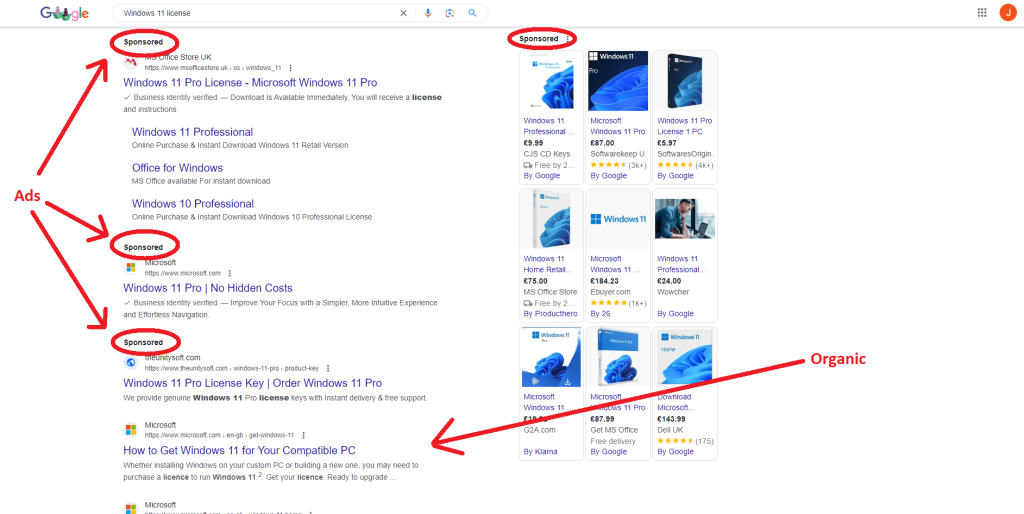
    A Google Search Engine Results Page for the search term "Windows 11 license" with arrows pointing out the Paid Ad and Organic results

    Some other types of PPC Ads include Display Advertising, which typically serve banner ads, and Remarketing.

    How does PPC work?

    Pay-per-Click Advertising operates on a bidding system. Advertisers cannot simply pay more to ensure their ads appear more prominently than their competitors. Ads are instead subject to an “Ad Auction”, this is a completely automated process that google and other major search engines use to determine the relevance and validity of an advertisement to a user’s search query and the respective SERP.

    Need help with PPC? Or want to start a new Ad Campaign? Click here!

    How do keywords work in Pay-Per-Click Advertising?

    As mentioned in the above section, an Ad Action is a bidding system. Advertisers must decide which terms they would like their ads to display for when a user makes a search. These terms are known as Keywords. Say, for example, that your business specializes in Office Supplies. A user looking to buy Printer Paper or Ink may enter the keyword “Office Supplies” into a search engine to find retailers offering these products.
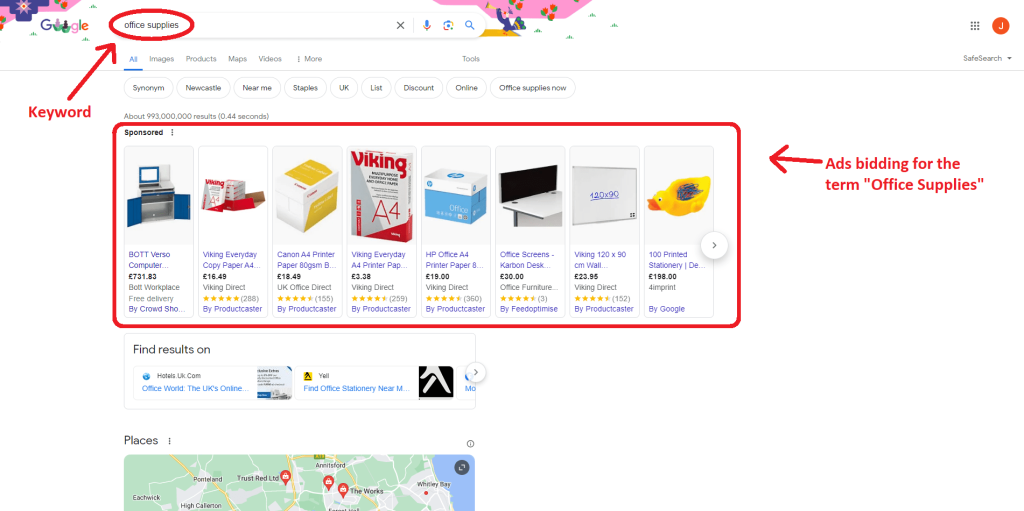
    A Search Engine Results page highlighting the PPC results for the search term "office supplies".

    The moment a user submits a search query, the search engine performs a series of complex algorithmic calculations that the Ad Auction is based on. This determines which ads are displayed, in what order and by which advertiser.

    Since you pay for every click your ad receives, its important to only bit on keywords that are relevant to your products or services. Bidding on irrelevant keywords would produce a poor return on investment (ROI) for your Ad Campaign. Specialized keyword research allows you to bid on terms that are more likely to have a high ROI and produce a successful campaign for your business.

    Ready to take your visibility to the next level with Pay-Per-Click?

    Pay-Per-Click Advertising is an extremely powerful tool that can produce exceptional return on investment for businesses. PPC can be applied to almost any sector and can help provide instant results when compared to Organic search techniques.

    Here at Social+ our Paid Search Experts are here to help your business with its new or existing Ad Campaigns. With our dedicated Keyword research, Ad Copy creation, and Ad Optimization, we can help kickstart your paid search journey.

    Click here to find out more! Additionally, why not take a look at our socials to see what we’re about –  Facebook, Instagram, and LinkedIn.

  • Tailoring Your Message: The Art of Targeted Social Media Content

    Tailoring Your Message: The Art of Targeted Social Media Content

    In the fast-paced world of digital marketing, the ability to connect with your audience on a personal level is more crucial than ever. As businesses navigate the dynamic landscape of online commerce, one key strategy stands out for its impact on sales: the art of targeted social media content. In this blog post, we’ll explore the significance of targeted social media content in the realm of digital marketing and its undeniable influence on driving sales.

    Understanding Targeted Social Media Content

    Targeted social media content is more than just a buzzword; it’s a strategic approach to crafting messages tailored specifically to a defined audience. Unlike generic content that attempts to appeal to a broad spectrum, targeted content hones in on the preferences, behaviours, and demographics of a particular audience segment. This approach allows businesses to speak directly to the needs and interests of their ideal customers.

    Building Meaningful Connections

    One of the primary advantages of targeted social media content is its ability to foster genuine connections with your audience. By understanding your audience’s pain points, desires, and behaviours, you can create content that resonates on a deeper level. This connection, in turn, builds trust and loyalty, transforming casual followers into engaged customers.

    Enhancing Engagement and Interaction

    Targeted social media content encourages active engagement. When users find content that directly speaks to their interests or needs, they are more likely to like, share, comment, and click through. This heightened level of interaction not only boosts your brand’s visibility but also increases the likelihood of converting leads into actual sales.

    Driving Traffic to Your Website with Targeted social media content

    A well-thought-out social media content strategy can significantly impact website traffic. By strategically placing calls-to-action within your targeted content, you guide users to explore your website further. This increased traffic provides more opportunities for conversions and sales.

    Optimising Return on Investment (ROI)

    In the realm of digital marketing, return on investment is a critical metric. Targeted social media content allows businesses to allocate resources more effectively by focusing on the channels and messages that resonate most with their audience. This optimisation ensures that marketing efforts generate a higher return on investment, both in terms of time and money.

    Navigating the Algorithms: Quality Over Quantity

    In the era of algorithm-driven social media platforms, the quality of your content matters more than ever. Simply bombarding your audience with frequent posts won’t cut it. Search engines and social media algorithms prioritise content that is relevant, engaging, and valuable to users. Hence, the emphasis should be on creating fewer but high-quality, targeted social media posts that genuinely captivate your audience.

    Strategies for Crafting Targeted Social Media Content

    Audience Segmentation: Divide your audience into segments based on demographics, interests, or behaviours. Craft content that specifically addresses the unique needs and preferences of each segment.

    Personalised Messaging: Use personalisation techniques to address your audience directly. Mention their pain points, preferences, or aspirations to create a sense of connection.

    Visual Appeal: Incorporate visually appealing elements into your content. High-quality images, infographics, and videos can capture attention and convey your message more effectively.

    Analytical Insights: Leverage analytics to understand what types of content perform best with your audience. Analyse metrics such as engagement rates, click-through rates, and conversions to refine your strategy over time.

    Conclusion

    In the dynamic landscape of digital marketing, the importance of targeted social media content cannot be overstated. This artful approach enables businesses to forge meaningful connections, enhance engagement, drive website traffic, and optimise ROI. By tailoring your message to the specific needs and interests of your audience, you not only stand out in the crowded digital space but also lay the foundation for increased sales and long-term customer relationships. Embrace the art of targeted social media content, and watch as your digital marketing efforts translate into tangible business success.

    Want to leave your Digital Marketing to the professionals and take your online presence to the next level?

    With the right blend of creativity, data-driven insights, and strategic planning, your business can unlock a world of opportunities and chart a successful path in the digital age. This is where we come in.

    Staying up-to-date with the latest trends and adapting your strategies to appeal directly to your audience is key to staying ahead in the digital landscape. Here at social+, we are constantly evolving our strategies based on customer behaviour, the latest trends and regular algorithm updates.

    Learn more about our digital marketing services or request a Free digital marketing audit.

    Additionally, why not take a look at our socials to see what we’re about – Facebook, Instagram, and LinkedIn.

  • From Clicks to Conversions: The Critical Role of Digital Marketing in Sales

    From Clicks to Conversions: The Critical Role of Digital Marketing in Sales

    In today’s fast-paced and highly competitive business landscape, the significance of digital marketing in driving sales cannot be overstated. As consumer behaviour continues to evolve, businesses must adapt their strategies to meet the demand. This is where digital marketing plays a pivotal role, acting as a bridge that connects potential customers to products and services. In this blog post, we’ll delve into the importance of digital marketing in sales and explore how businesses can leverage this powerful tool to boost conversions.

    Understanding Digital Marketing in Sales

    Digital marketing encompasses a wide range of online channels and tactics, including social media marketing, content marketing, search engine optimisation (SEO), email marketing, and more. Unlike traditional marketing methods, digital marketing allows businesses to reach a global audience in real-time.

    Enhanced Visibility and Brand Awareness

    One of the primary benefits of digital marketing in sales is the ability to enhance visibility and build brand awareness. Through strategic use of SEO techniques, businesses can optimise their online presence and appear prominently in search engine results. This increased visibility not only attracts more visitors but also fosters brand recognition, creating a strong foundation for sales success.

    Imagine a potential customer searching for a product or service online. Effective Search engine optimisation helps your business appear at the top of search results, making it more likely for the user to click on your website. This initial click is the first step in the sales journey.

    Targeted Reach and Personalisation

    Digital marketing allows businesses to target specific audiences based on demographics, interests, and online behaviour. Through platforms like social media and online advertising, businesses can tailor their messages to resonate with the right audience, increasing the likelihood of attracting potential customers genuinely interested in their products or services.

    Moreover, personalisation in digital marketing goes beyond just targeting. Email marketing, for example, allows businesses to send personalised messages directly to their audience’s inbox. By understanding customer preferences and behaviour, businesses can create highly targeted and relevant content. This helps nurture leads and driving them closer to conversion.

    Engagement and Relationship Building

    Building meaningful relationships with customers is crucial for long-term success. Digital marketing facilitates engagement through various channels, such as social media, where businesses can interact with their audience in real time. Responding to comments, addressing concerns, and showcasing the human side of the brand all contribute to building trust and loyalty.

    In the sales process, engagement is not just about attracting customers but also about keeping them interested throughout their journey. Consistent and valuable content, shared through blogs, videos, or social media, keeps the audience engaged and nurtures a sense of community around the brand.

    Data-Driven Decision Making

    Digital marketing provides businesses with valuable data and analytics to measure the effectiveness of their strategies. From website traffic to social media engagement, businesses can track various metrics to gain insights into customer behaviour. This data-driven approach enables businesses to make informed decisions, refine their strategies, and allocate resources more efficiently.

    By analysing customer data, businesses can identify trends, preferences, and pain points. This information is invaluable in tailoring marketing strategies to better meet customer needs, ultimately driving more targeted and successful sales efforts.

    Conclusion: The Power of Digital Marketing in Sales

    In the ever-evolving landscape of business, adapting to the digital era is not an option but a necessity. Digital marketing serves as the linchpin that connects businesses with their target audience, guiding potential customers from initial clicks to final conversions. The strategic use of online channels, targeted messaging, and data-driven insights all contribute to a robust digital marketing strategy that can significantly impact sales growth.

    As businesses navigate the complexities online markets, understanding and harnessing the power of digital marketing in sales is key to staying ahead of the competition. From enhancing visibility and brand awareness to fostering engagement and building lasting relationships. Digital marketing is the driving force that propels businesses forward in the dynamic and interconnected world of today.

    Want to leave your Digital Marketing to the professionals and take your online presence to the next level?

    With the right blend of creativity, data-driven insights, and strategic planning, your business can unlock a world of opportunities and chart a successful path in the digital age. This is where we come in.

    Staying up-to-date with the latest trends and adapting your strategies accordingly is key to staying ahead in the digital landscape. Here at social+, we are constantly evolving our strategies based on customer behaviour, the latest trends and regular algorithm updates.

    Learn more about our digital marketing services or request a Free digital marketing audit.

    Additionally, why not take a look at our socials to see what we’re about – Facebook, Instagram, and LinkedIn.
  • Digital Marketing Strategies: The key to growing your business in the digital age

    Digital Marketing Strategies: The key to growing your business in the digital age

    In today’s fast-paced and interconnected world, effective digital marketing strategies are essential for business success.

    Traditional marketing methods alone no longer suffice when it comes to achieving business growth and success. Businesses must embrace innovative strategies that leverage the power of the internet and technology to reach their target audience effectively.

    This is where digital marketing strategies come into play, acting as the driving force behind a business’s expansion and visibility in the online realm.

    Understanding Digital Marketing Strategies

    Digital marketing strategies encompass a diverse range of tactics aimed at promoting products, services, or brands through various online channels.

    Unlike traditional marketing, digital marketing allows you to tailor your efforts to specific demographics. As a result, this ensures that your message reaches the right people at the right time.

    But what aspects of digital marketing determine an effective strategy? This could be a pretty difficult question to answer if you have no experience in the digital world. That’s why agencies like us are on hand to help create and implement an effective strategy for your business.

    Let’s delve into some key aspects of digital marketing strategies that can propel your business to new heights:

    Search Engine Optimisation (SEO)

    In a world where search engines are the go-to source for information, ranking high on SERPs is crucial.

    SEO involves optimising your website’s content, structure, and backlinks to improve its visibility on search engines.

    By strategically incorporating relevant keywords, producing high-quality content, and enhancing user experience, your business can attract organic traffic and gain a competitive edge.

    Website Maintenance

    Website maintenance is a critical aspect of maintaining a successful and functional online presence.

    A website requires regular upkeep to ensure it operates smoothly and remains relevant to its audience.

    Regular maintenance tasks, such as updating software, plugins, and security measures will enhance website performance. Additionally, it will safeguard your website against potential vulnerabilities.

    Content Marketing

    Content is the backbone of digital marketing. As part of your strategy, we will craft compelling and valuable content in the form of:

    • blog posts
    • social media content
    • videos
    • infographics
    • and more

    This can establish your business as an authority in your industry. Sharing informative content not only engages your audience but also fosters trust and loyalty. This ultimately results in driving more conversions and sales.

    Social Media Management

    Social media platforms have transformed into powerful marketing tools. They allow businesses to interact with their audience on a personal level.

    Through targeted advertising, engaging posts, and community building, you can amplify your brand’s voice. As a result, this will allow you to create lasting connections with customers.

    Pay-Per-Click Advertising (PPC)

    PPC campaigns, such as Google Ads, allow businesses to bid for ad placements on search engines and other online platforms.

    This strategy ensures your ads are displayed to users searching for specific keywords, driving immediate traffic to your website. With careful keyword selection and ad optimisation, PPC can provide a high ROI.

    Email Marketing

    Despite being one of the oldest digital marketing strategies, email marketing remains highly effective.

    Sending personalised and relevant emails to subscribers has multiple benefits. These include nurturing leads, maintaining customer relationships, and encouraging repeat purchases.

     Automation tools make it easier to send targeted emails based on user behavior and preferences. As a digital marketing agency, we have access to these tools and can take care of this for you. As a result, you can get on with running your business.

     Analytics and Data Analysis

    One of the most significant advantages of digital marketing is the ability to track and analyse data in real-time.

    Tools like Google Analytics provide insights into user behavior, website traffic, conversion rates, and more.

    By understanding these metrics, we can refine your strategies and make data-driven decisions for continuous improvement.

    Ready to get started with effective digital marketing strategies?

    Remember that digital marketing is a dynamic field that continuously evolves with technological advancements and changing consumer behaviors.

    Staying up-to-date with the latest trends and adapting your strategies accordingly is key to staying ahead in the digital landscape.

    With the right blend of creativity, data-driven insights, and strategic planning, your business can unlock a world of opportunities and chart a successful path in the digital age. This is where we come in.

    Here at Social+, our team of experienced professionals are dedicated to helping businesses like yours utilise the digital space to best benefit your business.

    Learn more about our digital marketing services or request a Free digital marketing audit.

    Additionally, why not take a look at our socials to see what we’re about – Facebook, Instagram, and LinkedIn.
  • LinkedIn Algorithm Changes –

    LinkedIn Algorithm Changes –

    What’s new and how does it affect you?

    LinkedIn Algorithm Changes – It has made some pretty big changes to its algorithm and how it prioritises posts and content for its users. This information comes via Jason Feifer of Entrepreneur, who recently spoke to the LinkedIn team about their updates. In this blog, we cover everything you need to know to stay relevant to the new changes.

    There are two main changes affecting the reach of posts on LinkedIn:

    1. If you post on LinkedIn, it is now more likely that your followers will see your post.

    This change comes after users preferred content from people they “know and care about”, saying they found content from their own connections more valuable. Already, LinkedIn has seen a 10% increase in people viewing posts from people they know. If you want to prioritise your impressions, now would be the time to do it!

    2. Posts that share “Knowledge and Advice” are now prioritised throughout the platform.

    This change goes hand in hand with the first – Posts sharing “knowledge and advice” will now be a primary way to reach people who are not current connections. LinkedIn’s system will now evaluate whether a post contains knowledge and advice, categorise it, and show it to other users whom it deems likely to find it relevant and useful. LinkedIn aims to provide greater value to help its users feel “more productive and successful”. With this shift to value-based algorithm changes it is more important than ever to produce high-quality social media posts.

    But how does the LinkedIn algorithm identify “Knowledge and Advice”?

    While they haven’t told us every metric they use to classify posts, they have given us a few. From everything we know, it looks like LinkedIn is making a shift to prioritising quality and relevant posts and content to bring more value to its users. A few of the new metrics used to identify posts providing “knowledge and value” include:

    The post speaks to a distinct audience – The system will look at posts and ask, “Who is this relevant to”. For example, a personal birthday post would most likely only go to close connections. While a post on B2B advertising would be visible in that sector regardless of connection status. Following this, the post’s success depends on whether it provides good advice and value to other users.

    The author is writing in their core subject area – Now when posting on LinkedIn, the platform isn’t just evaluating the value of your post. It’s now also evaluating you, and the value you hold in your core subject area. Engaging in your core subject area builds a trust factor and lets LinkedIn you are relevant in that category. Your previous post’s success in a given category will increase your visibility too. There has been an overall shift to providing higher quality and relevant content to its users.

    The post has “meaningful comments” – In the past LinkedIn would amplify posts with a lot of comments. As a result, some users banded together to create “engagement groups” where they agree to like and comment on posts. LinkedIn wanted to stop this and now random comments of “great” or “so true” will not hold value. Relevant comments to the content itself and responses from the original poster will have significantly more value. The algorithm will see these exchanges as a “conversation” that other people may find value in and boost this instead.

    Need a little help with the LinkedIn Algorithm Changes or your company’s Social Media?

    Here at Social+, we understand the world of social media is fast-paced and constantly changing.

    We also know how time-consuming and complicated it can be to keep on top of fast-paced changes.

    That’s where we come in. We’re on hand ready to assist you with all your digital marketing and website needs.

    We cover everything from assisting with social posts to fully managed social packages.

    We cater to businesses of all sizes and industries, and we tailor your package to your business needs.

    Why not look at our socials to see what we’re about – Facebook, Instagram, and LinkedIn.

  • But it’s my business, how will you know what to post?

    But it’s my business, how will you know what to post?

    Thinking about outsourcing your digital marketing for your business but still on the fence?

    Are you worried about losing the personal touch your brand has?

    In this blog, we detail the process we go through as a digital marketing agency to ensure you still love the content your brand puts out after outsourcing your digital marketing.

    Discovery meetings

    One of the first things we do when taking on a new client is to host a discovery meeting.

    A discovery meeting is an investigative meeting that we use to learn more about your business and project requirements.

    By gaining key information about your current projects, we can better market them on your socials and tailor your website.

    During these meetings, we ask questions to help us better understand your:

    • Goals
    • day-to-day operation
    • needs for your business.

    Industry research

    After discovery meetings have taken place, we would then do a deep dive and research in depth into your industry.

    We look at the latest trends and how your business can take advantage of them.

    This research is important to ensure that your content targets the right people and is seen by them.

    It also allows us to evaluate the most effective channels to use for your business. Not all social media platforms are right for every business.

    Business and website audit

    The research from the previous section goes hand in hand with our business and website audits.

    These audits take place to ensure that we are marketing content in the best way for your business.

    What is already working well for you and where more attention is needed for certain products or services.

    The website audit allows us to see strengths and weaknesses in your existing website and socials (if you already have these).

    Following these audits, we have an even stronger understanding of the priority list for your business.

    Creating a tailored plan

    Based on the information from our audits and in-depth market research we create a plan specific to your business.

    This plan works as a guide alongside your continued input to ensure the content we create, and post is effective and engaging.

    This planning allows us to amend any weaknesses and strengthen your marketing strategy.

    Social listening

    We practice social listening; this is the practice of monitoring mentions of your brand on social media channels.

    This also means monitoring mentions of your competitor’s brands and related keywords.

    Tracking these mentions in real time gives you insights into how customers feel about your products and services.

    By also tracking competitors and trending content we can see what is and isn’t working for others.

    Adjusting your approach based on both your own data and competitors’ hard data gives you a better chance of success!

    Strategy meetings

    Our communication doesn’t stop after our initial meetings, we have regular strategy meetings with clients Bi-monthly.

    These meetings allow us to update you on how the strategy is evolving.

    Regular meetings let us take on any feedback or changes you may want to make.

    We believe strategy meetings are important to ensure you are happy with the work we are doing.

    They are also a great way to keep you updated with the progress your business is making online.

    Reporting

    We regularly send you reports and updates with analytics and hard data on how your socials and website are performing.

    We use a variety of cutting-edge analytics tools to track all aspects of social media posting and website traffic.

    This varies from basic interaction with posts to the demographic and details of potential customers.

    By using collected data, we are able to continue tailoring posts to further increase traffic or completely redirect it to a different target audience.

    Need a little help with your digital marketing?

    Here at Social+, we understand how important the content you put out is.

    We know how time-consuming and stressful it can be to keep on top of all of your social media platforms.

    That’s where we come in. We are on hand ready to assist you with all your digital marketing and website needs.

    We cater to businesses from a range of industries, and we tailor your package to your business needs.

    Visit our website for more information!

    Additionally, why not look at our socials to see what we’re about – Facebook, Instagram, and LinkedIn.

  • PPC Marketing: What is PPC and how can it impact your business?

    PPC Marketing: What is PPC and how can it impact your business?

    What is PPC?

    Pay-per-click (PPC) marketing has become one of the most powerful tools for businesses. It can be utilised to advertise your products and services online.

    PPC marketing is a popular advertising model. This is when businesses pay a fee each time a potential customer clicks on one of their ads.

    PPC ads are shown in search results on Google, Bing, and Yahoo. When someone searches for something related to what you sell, the keyword(s) in your ad will show up alongside organic results at the top or bottom of their screen when they click on it.

    The more relevant keywords you use in your ad copy, title, and description–and the more often those words appear on your website–the more likely it is that someone will come across it when searching online!

    In this blog post, we will explore the many benefits that PPC advertising can offer to businesses of all sizes.

    Cost-Effective

    One of the primary benefits of PPC marketing is that it is a cost-effective way of reaching out to potential customers.

    Traditional advertising methods involve you paying upfront for an ad in the hope that it will attract customers. On the other hand, PPC advertising charges businesses only for actual clicks on their ads. This means that businesses can tailor their marketing budgets according to their needs and target audience.

    Targeted Advertising

    PPC marketing allows businesses to target specific audiences based on various criteria including:

    • Age
    • Gender
    • Location
    • interests

    This means businesses can show their ads directly to people who are most likely to be interested in their products or services. This maximises the chances of attracting potential customers. Additionally, it saves money on advertising costs by only targeting relevant audiences.

    Measurable Results

    PPC marketing provides businesses with in-depth data on the performance of their ad campaigns. This includes metrics such as:

    • impressions
    • clicks
    • conversions
    • and other valuable insights

    Businesses can use these metrics to refine their ad campaigns for better results. By analysing this data, businesses can:

    • adjust their ad campaigns
    • optimise their budgets
    • improve their targeting to maximise ROI in the long run.

    Fast Results

    Traditional advertising methods can take time to generate results. As opposed to this, PPC marketing delivers fast results.

    By targeting relevant audiences with engaging ads, businesses can see an immediate influx of traffic to their website within a short period. This can be especially useful for businesses that are launching new products or services. And for those that need to need to generate interest and sales quickly.

    Competitive Advantage

    PPC marketing provides businesses with a competitive advantage. It allows them to bid on specific keywords and phrases to rank higher than their competitors in search engine results.

    This means that businesses can appear at the top of search engine results, As a result, potential customers are more likely to click on their ads instead of those of their competitors.

    Should your business ultilise PPC advertising?

    PPC marketing is an effective marketing tool that can help businesses of all sizes in numerous ways.

    By reducing advertising costs, targeting specific audiences, producing measurable results quickly, and providing a competitive advantage, businesses can reach their desired audience, generate more leads, and increase sales.

    Need a little help with your PPC?

    Here at Social+, we understand that PPC is an effective way to reach a potential customer.

    It’s also a great way to reach people who are actively looking for products and services like yours. This means you can increase your chances of selling something.

    We cater to businesses from a range of industries, and we tailor your package to your business needs.

    Visit our website for more information!

    Additionally, why not take a look at our socials to see what we’re about – Facebook, Instagram, and LinkedIn.
  • Full circle digital marketing: Brand identity

    Full circle digital marketing: Brand identity

    What is it?

    Brand identity is the face of your brand. Your brand identity is the combination of visual, content, and tone choices to represent the personality of your business.

    Your visual brand identity is composed of the visual elements you have depicted. This could include fonts, colours, and content. Additionally, this also includes your brand’s tone of voice and how you present yourself to your audience.

    Elements of brand identity could include:

    • Fonts
    • Colours
    • Layouts
    • Design elements
    • Tone of voice
    • Tagline
    • Brand values
    • Messaging

    Your brand identity is defined by your purpose, values, and mission. It should tell the story of your brand and have its own personality.

    Why is it important?

    In today’s digital space, there’s so much competition from different businesses. If you want to succeed, you need to stand out.

    It’s important to create a strong and consistent brand identity to be easily recognisable to your target audience.

    This is what sets you apart from your competitors. You need to highlight what is different about your business and why your audience should choose your products/services.

    How to create a consistent brand identity

    Align your digital components

    Aligning all digital components will help to create a clear and consistent brand identity. It’s important to convey consistent messaging across all digital components including your:

    • Website
    • Social Media
    • Email Marketing

    Although each digital aspect has a different purpose, they should ultimately promote the same message.

    Does your business promote a more serious product or service? Or are you more on the fun side? Your content should align across all channels distinguishing who you are as a brand and what you stand for.

    Develop brand guidelines when creating content

    Your brand guidelines can be defined as a set of rules to explain how your business visually presents itself.

    Your brand guidelines consist of:

    • Logos
    • Colours
    • Typography
    • Imagery
    • Graphics

    Utlisling brand guidelines ensure that your brand both looks and feels the same across all touchpoints. Whether it be your website, social media, or weekly newsletter, your brand is easily identifiable through these elements.

    Incorrect colours, random fonts, and misplaced logos can all factor in disrupting your brand identity. Your brand identity should be at the forefront of everything you do and your visual elements should reflect this.

    Delivering your brand clearly and consistently when networking

    Networking is great for making new connections and building relationships with like-minded individuals. However, for this to be beneficial to your business, you need to know what you’re talking about.

    Having a clear brand identity will help you to convey your business to others. On the other hand, mixed messaging can have the opposite effect. If you don’t know what you’re talking about, it can be damaging to the reputation of your business.

    A strong brand identity will allow you to present who you are and what you do with ease.

    Are you interested in attending networking events and getting your business out there? We offer monthly events through Network Plus.

    To take a look at our upcoming events, click here.

    Need a little help creating a consistent brand identity for your business?

    Whether you’re a newer business starting to create your brand identity or need a little help with your existing one, we can help!

    At Social Plus, we offer Full Circle Digital Marketing. This service runs on the concept that all your digital marketing components should align and work together in harmony.

    We work with our clients to create the best strategy for their business from choosing the right platforms to be on, creating engaging content for your audience, and finding your people.

    We cater to businesses from a range of industries, and we tailor your package to your business needs.

    Visit our website for more information!

    Additionally, why not take a look at our socials to see what we’re about – Facebook, Instagram, and LinkedIn.
  • Digital Marketing: Full Circle

    Digital Marketing: Full Circle

    The importance of your business being online

    In today’s working environment, having a strong online presence is crucial for business success.

    The competition is fierce and traditional marketing isn’t enough anymore. However, the use of digital tools can help you stand out from the crowd.

    With an effective Digital marketing strategy, you can increase brand awareness, build a community, and sell your products/services. Additionally, it can open doors for your business that you may never have considered possible before.

    Social Media Management

    The use of social media has and continues to rapidly grow. It’s not just for the use of Gen Z anymore. From young adults to parents, to grandparents, there are estimated to be over 4 billion social media users worldwide.

    The first step is making sure you are on the right platforms to reach your target audience. It’s better to achieve an effective strategy on 1 or 2 platforms at first as opposed to spreading yourself to thin to begin with.

    Consistent posting of quality content is a key factor within an effective social media strategy. Even if it’s just one post per week to begin with. It’s important to make sure you’re sticking to a consistent posting schedule.

    In addition to this, it’s important to make sure the content you’re posting is of a high standard. As the old saying goes, quality over quantity. Quality content will add value to your audience and is more likely to interest new audiences.

    Website

    Your website is the digital face of your business. A user-friendly website could be the determining factor of business success.

    We often talk about the importance of website maintenance. But why is it so important?

    Your website needs to be user-friendly. Without regular maintenance, this isn’t so easy to obtain. Lack of website maintenance can result in your website becoming slow and outdated. Out-of-date plugins can take longer to load, meaning your website must work harder.

    Furthermore, without maintenance, your website is more vulnerable to cyber threats. Plugin updates often contact security patches and updates that make your website stronger and protected against cyber-attacks.

    On the other hand, with regular maintenance, the user experience will be Improved. A quick and engaging functional website will always be favoured over a website with broken links and dead ends.

    SEO

    Search Engine Optimisation is a key factor in the success of any website.

    It refers to the process of optimising a website to improve the website’s ranking in search engines like Google.

    Some of the factors that work towards an optimised website include:

    The different types of SEO include:

    On-page – Focuses on optimising parts of your website you can control.

    Off-page – Concentrates on increasing your domain’s authority through efforts outside your website.

    Technical – The process of ensuring that a website meets the technical requirements of modern search engines with the goal of improved organic rankings.

    Local – Helps your business be more visible in local search results on Google.

    Google My Business

    Google my business is your business profile that appears on the right of the Google search results when someone is searching for your business or similar businesses on Google.

    Your GMB profile could be the first touch point for a local potential customer to discover your business.

    The benefits of a GMB profile for your business include:

    • Improving SEO
    • Leading to increased conversions
    • Increasing brand awareness
    • Building trust with your audience
    • Providing valuable customer insights

    Email Marketing

    Email marketing allows you to utilise emails to the advantage of your business. It allows you to get to know your customers better and for them to learn more about you.

    Emails can add value to your customers by providing updates on new services and offers. In addition to this, they can add value to your business by using such offers to gather customer data.

    Furthermore, a monthly newsletter is a great way of keeping your customers informed. This could include what the business has been getting up to and any upcoming offers or events.

    Email marketing provides an opportunity to engage with new potential customers as well as current ones. Ways to build your list and keep people engaged include:

    • Downloadable PDFs
    • Offers
    • Surveys
    • Events

    Blogs

    Blogs have multiple benefits including:

    • Contributing to improved SEO
    • Repurposing content for social media
    • Helping to convert traffic into leads
    • Driving long-term results
    • Helping with link building
    • Positioning you as a thought leader within your industry

    Need a little help with your digital marketing?

    Here at Social+, we understand the importance of an effective digital marketing strategy.

    When it comes to outlining a digital strategy, there are lots of different factors to consider.

    Determining and carrying out an effective strategy can be difficult with all your other responsibilities to think about.

    That’s where we come in. We take care of your digital marketing so you can focus on the running of your business.

    We cater to businesses from a range of industries, and we tailor your package to your business needs.

    Want to know more? Get in touch today!

    Additionally, why not take a look at our socials to see what we’re about – Facebook, Instagram, and LinkedIn.
  • SEO: The different types of search engine optimisation

    SEO: The different types of search engine optimisation

    What is SEO?

    In the world of digital marketing, search engine optimisation (SEO) is an important factor in any website’s success.

    SEO refers to the process of optimising a website to improve its ranking on search engines like Google.

    Some of the factors that work towards an optimised website include:

    • Keyword research
    • Content quality and relevance
    • Page load speed
    • Mobile optimisation

    Not only are there different factors that contribute to website optimisation, but there are also different types of SEO. Digital marketing experts use a range of different SEO techniques to help businesses improve their online presence.

    Why is SEO important?

    The better your SEO, the higher your website will appear in search engine results. This makes it easier for potential new customers to come across your website.

    Paid ads, social media, and other online platforms can drive traffic to websites. However, the majority is driven by search engines.

    Paid ads are great because they allow any business, at any stage, to boost its traffic or brand awareness. However, paid ads can be limited by the language and locations you are targeting. On the other hand, these limitations do not apply to organic search listings. As a result of this, it’s possible to have more organic impressions than paid ones.

    Today’s digital landscape is competitive. A strong SEO strategy will allow your website more visibility in search engine results.

    In addition to search engine visibility, good SEO practices improve the user experience and useability of a website.

    On-page SEO

    On-page SEO involves optimising individual web pages to rank higher and generate more relevant traffic. This includes optimising the content on the page, optimising the page title and meta descriptions, internal linking, and URL structure.

    Off-page SEO

    Off-page SEO refers to the activities carried out outside of the website to improve its ranking, such as link building, social media marketing, and online PR. Link building involves acquiring backlinks from high-authority websites to boost the website’s credibility.

    Technical SEO

    Technical SEO focuses on improving the technical elements of a website to ensure that search engine crawlers can easily crawl and index the website. This includes optimising website speed, mobile responsiveness, and fixing broken links.

    Local SEO

    Local SEO refers to the process of optimising a website to appear in local search results. This includes optimising local directories, creating location-specific content, and using location-based keywords.

    International SEO

    International SEO involves optimising a website to target customers in different countries and languages. This includes creating localised content, using language-specific keywords, and optimising website structure for multilingual search engines.

    Does your business need some help with SEO?

    In conclusion, SEO is a vital part of any digital marketing strategy. By using the various types of SEO techniques available, businesses can improve their online visibility and attract more relevant traffic to their website.

    Are you looking to improve your SEO but just don’t know where to start?

    An effective SEO strategy is crucial to driving traffic to your website and building your brand awareness. However, there’s lots to think about and it takes time to plan an effective strategy.

    Here at Social Plus, we understand that a good website is one that can be found easily.

    Whether it’s designing or maintaining a website, search engine optimisation is at the forefront of what we do.

    It’s our goal to take care of your SEO strategy so you can get on with running your business!

    We offer basic optimisation and basic SEO as standard to all website clients on whichever package they choose. Additionally, we also have options to upgrade to Premium SEO.

    Keep an eye out on our socials for more content like this: Facebook, LinkedIn, and Instagram.

    Or why not visit our website and request a free website audit.