Tag: Paid Ads

  • The Impact of Sponsored Search Results on User Behaviour

    The Impact of Sponsored Search Results on User Behaviour

    Understanding how users interact with different elements on a search engine results page (SERP) is crucial. One of the most significant factors influencing user behaviour is the presence of sponsored search results. These paid advertisements, strategically placed at the top of the SERP, play a vital role in how users navigate the web and make decisions.

    The Visibility Advantage of Sponsored Search Results

    Sponsored search results are prominently displayed at the top of the SERP, often above the organic results. This prime positioning is not just a matter of convenience; it’s a strategic move designed to capture user attention. Studies show that users are significantly more likely to click on links that appear at the top of the page, simply because these links are the first ones they see. This visibility advantage means that sponsored Ads can drive a substantial amount of traffic to advertisers’ websites.

    Immediate Trust and Credibility

    Users tend to associate top-ranking results with credibility and trustworthiness. When they see sponsored search results at the top of the SERP, many assume these links are reputable and worth clicking on. This perception is further reinforced when the ad copy is well-crafted and relevant to their search query. Effective ad copy includes compelling headlines, clear value propositions, and a strong call to action, all of which can significantly influence user engagement.

    User Intent and Sponsored Search Results

    Understanding user intent is essential for optimising PPC campaigns. Sponsored search results are particularly effective for capturing users with high commercial intent. For example, someone searching for “buy running shoes” is likely ready to make a purchase. Sponsored links that appear for such queries are more likely to receive clicks because they align perfectly with the user’s intent. By targeting high-intent keywords, advertisers can maximise their return on investment (ROI) from PPC campaigns.

    Click-Through Rates and Engagement

    Click-through rates (CTR) are a critical metric for assessing the effectiveness of sponsored search results. Data consistently shows that links at the top of the page, including sponsored ones, receive higher CTRs compared to those further down. This higher engagement is not only due to their visibility but also because users often find what they are looking for within the first few results. As a result, they are less likely to scroll down the page, making top positions even more valuable.

    The Role of Ad Relevance and Quality Score

    Search engines like Google use a Quality Score to evaluate the relevance and quality of sponsored search results. This score considers factors such as the ad’s relevance to the search query, the quality of the landing page, and the historical performance of the ad. Ads with higher Quality Scores are more likely to appear at the top of the SERP, further enhancing their visibility and click-through potential. Advertisers who focus on creating highly relevant and user-friendly ads can improve their Quality Scores and gain a competitive edge.

    User Behaviour Insights

    Analysing user behaviour can provide valuable insights into the effectiveness of sponsored search results. Heatmaps and eye-tracking studies reveal that users’ attention is predominantly focused on the top section of the SERP. Sponsored search results benefit from this behaviour, as users are more likely to notice and click on them. Moreover, users who click on sponsored search results tend to exhibit specific behaviours, such as higher engagement rates and increased likelihood of conversion, compared to those who click on organic results.

    The Psychological Impact of Sponsored Search Results

    The placement of sponsored search results also has a psychological impact on users. The mere fact that an ad appears at the top can create a sense of urgency and importance. Users may perceive these ads as more relevant to their needs, prompting them to click without scrolling further. Additionally, the presence of ad extensions, such as site links and callouts, can enhance the ad’s visibility and provide additional information that encourages user interaction.

    Balancing Sponsored and Organic Results

    While sponsored search results are highly effective, it’s important for advertisers to balance their PPC efforts with strong organic search strategies. Users trust organic results for informational queries and often rely on them for research purposes. By integrating both PPC and SEO strategies, businesses can ensure they capture a broader audience and cater to different stages of the buyer’s journey.

    Conclusion

    The impact of sponsored search results on user behaviour is undeniable. Their prominent placement at the top of the SERP significantly enhances visibility, trust, and engagement. By understanding the nuances of user intent, optimising ad relevance, and leveraging psychological triggers, advertisers can maximise the effectiveness of their PPC campaigns. As the digital landscape continues to evolve, staying informed about user behaviour and adapting strategies accordingly will be key to maintaining a competitive edge in the world of online advertising.

    Ready to take your PPC efforts to the next level?

    Here at Social+, we provide specialist Pay-Per-Click Ad creation and optimisation to help your business thrive. From dedicated Keyword research to Audience segmentation and strategic planning. Read more about our PPC services here!

    Additionally, why not take a look at our socials to see what we’re about –  Facebook, Instagram, and LinkedIn.
  • Social Media Ad Campaigns: Best Practices for 2024

    Social Media Ad Campaigns: Best Practices for 2024

    In Digital Marketing in 2024, social media ad campaigns remain a powerful tool for businesses to reach and engage with their target audiences. Staying ahead of the curve with best practices for social media ad campaigns is crucial for maximising ROI and achieving marketing goals. Here, we’ll explore the top strategies to ensure your social media ad campaigns are effective and impactful.

    Understand Your Audience

    The foundation of any successful social media ad campaign is a deep understanding of your audience. In 2024, leveraging advanced targeting options provided by platforms like Facebook, Instagram, and LinkedIn is essential. Utilise demographic, geographic, and behavioural data to create detailed audience personas. Understanding your audience’s preferences, pain points, and online behaviours will help you craft ads that resonate and drive engagement. At social+ all of our Ad campaigns are driven by forecasted and evidence-based data to produce successful campaigns.

    Set Clear Goals and KPIs

    Before launching your social media ad campaigns, define clear goals and key performance indicators (KPIs). Whether your objective is to increase brand awareness, drive website traffic, generate leads, or boost sales, having specific goals will guide your campaign strategy and measurement. Common KPIs include click-through rates (CTR), conversion rates, and cost per acquisition (CPA). Clear goals and KPIs ensure that you can measure the success of your campaigns and make data-driven adjustments.

    Craft Compelling Ad Creatives

    In 2024, the competition for users’ attention on social media is fiercer than ever. To stand out, your ad creatives must be compelling and visually appealing. Use high-quality images, engaging videos, and concise, persuasive copy. Ensure your creatives align with your brand identity and messaging. A/B testing different ad formats and visuals can help determine what resonates best with your audience. A/B testing refers running different versions of the same type of Ad to see which version is most effective for your audience.

    Leverage Video Content

    Video content continues to dominate social media and is predicted to remain a key trend in 2024. Incorporating video into your social media ad campaigns can significantly boost engagement and conversions. Whether it’s short-form videos for platforms like TikTok and Instagram Reels or longer content for Facebook and YouTube, videos can effectively convey your brand message and showcase your products or services in action.

    Utilise Advanced Targeting Options

    Social media platforms offer advanced targeting options that allow you to reach specific segments of your audience. In 2024, make the most of these capabilities by using custom audiences, lookalike audiences, and retargeting strategies. Custom audiences allow you to target users who have previously interacted with your brand, while lookalike audiences help you find new users similar to your existing customers. Retargeting ads to users who have visited your website or engaged with your social media profiles can also drive higher conversions.

    Optimise for Mobile

    With the majority of social media users accessing platforms via mobile devices, optimising your ad campaigns for mobile is essential. Ensure that your ad creatives are mobile-friendly, with clear, legible text and compelling visuals that look great on smaller screens. Fast-loading landing pages and mobile-responsive design are also critical for providing a seamless user experience and reducing bounce rates.

    Monitor and Adjust Your Campaigns

    Continuous monitoring of your social media ad campaigns is vital for success. Use analytics tools provided by social media platforms to track the performance of your ads in real time. Monitor key metrics such as engagement rates, CTR, and conversion rates. Based on the data, adjust your targeting, ad creatives, and bidding strategies to optimise performance. Regularly testing new ideas and iterating based on results will keep your campaigns fresh and effective.

    Budget Wisely

    Effective budgeting is crucial for the success of your social media ad campaigns. Allocate your budget based on your goals, audience size, and the platforms you’re using. Start with a test budget to gather initial data and insights. Once you identify high-performing ads and strategies, scale your budget accordingly. Remember to monitor your spending and ROI closely to ensure you’re getting the best value from your campaigns.

    Stay Updated with Platform Changes

    Social media platforms frequently update their algorithms, features, and ad policies. Staying informed about these changes is essential for maintaining the effectiveness of your social media ad campaigns. Follow industry blogs, attend webinars, and participate in online communities to stay abreast of the latest developments. Adapting quickly to platform updates can give you a competitive edge and help you leverage new opportunities.

    Conclusion

    As we approach the midpoint of 2024, mastering the best practices for social media ad campaigns will be crucial for marketers aiming to drive meaningful results. By understanding your audience, setting clear goals, crafting compelling creatives, leveraging video content, utilising advanced targeting, optimising for mobile, monitoring performance, budgeting wisely, and staying updated with platform changes, you can ensure your social media ad campaigns are both effective and efficient. Embrace these strategies to stay ahead in the competitive world of social media marketing.

    Want Social Media Ads, but don’t have the time or expertise to set them up?

    Here at Social+ our dedicated Search Marketing team and Social Media team are on hand to produce outstanding paid social media campaigns for your business. Our team will work with you to understand your business goals, product USPs and audience demographics.

    With Highly trained Ad specialists and top-of-the-line Account managers, we can do the research and creation for you, so you can focus on selling to your new leads!

    For more information, get in touch through our website or call us today! – 0191 466 1550

    Additionally, why not take a look at our socials to see what we’re about –  Facebook, Instagram, and LinkedIn.
  • Pay-Per-Click Advertising: What Is PPC & How does It Work?

    Pay-Per-Click Advertising: What Is PPC & How does It Work?

    What Is Pay-Per-Click Advertising?

    Pay-Per-Click Advertising or PPC is a digital marketing model in which advertisers pay a fee each time a user clicks one of their online Ads.

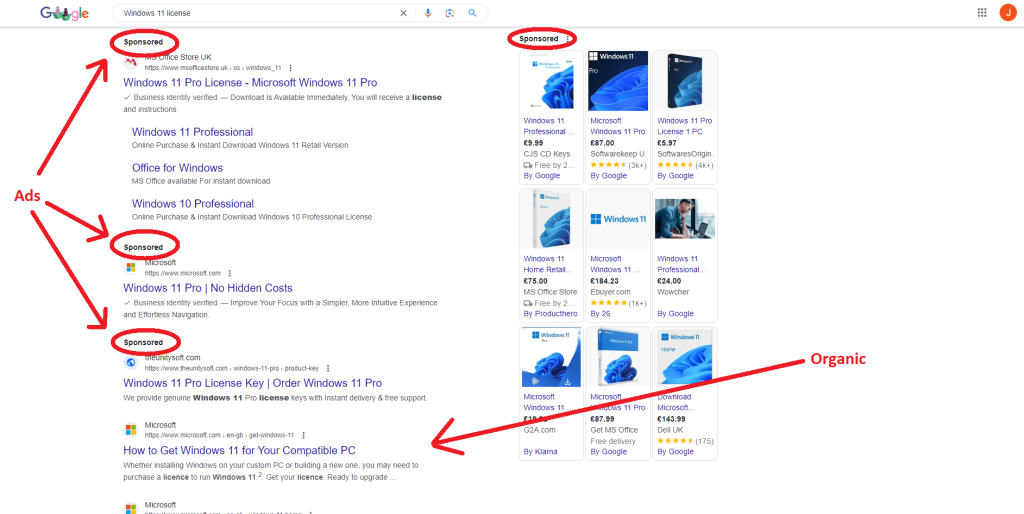
    There are many different types of PPC Ads, one of the most common types is the paid search Ad. This type of Ad appears when a user googles a search term that an advertiser is “bidding” on. These Ads appear in the SERP’s (Search Engine Results Page) alongside organic results. You can spot these Advertisements by looking for the “Sponsored” or “Ad” tag. These paid search Ads usually appear at the top and bottom of the Search engine results pages.

    Almost any search can trigger Pay-Per-Click Ads, for example someone may search for “Windows 11 License”, Alongside the organic results you may see Software or resale websites that have bid to have their Ad show with the intention of driving more sales or traffic to their website. When a user clicks one of these Ad links, the vendor is charged for each user that clicks through to the website.

    A Google Search Engine Results Page for the search term "Windows 11 license" with arrows pointing out the Paid Ad and Organic results

    Some other types of PPC Ads include Display Advertising, which typically serve banner ads, and Remarketing.

    How does PPC work?

    Pay-per-Click Advertising operates on a bidding system. Advertisers cannot simply pay more to ensure their ads appear more prominently than their competitors. Ads are instead subject to an “Ad Auction”, this is a completely automated process that google and other major search engines use to determine the relevance and validity of an advertisement to a user’s search query and the respective SERP.

    Need help with PPC? Or want to start a new Ad Campaign? Click here!

    How do keywords work in Pay-Per-Click Advertising?

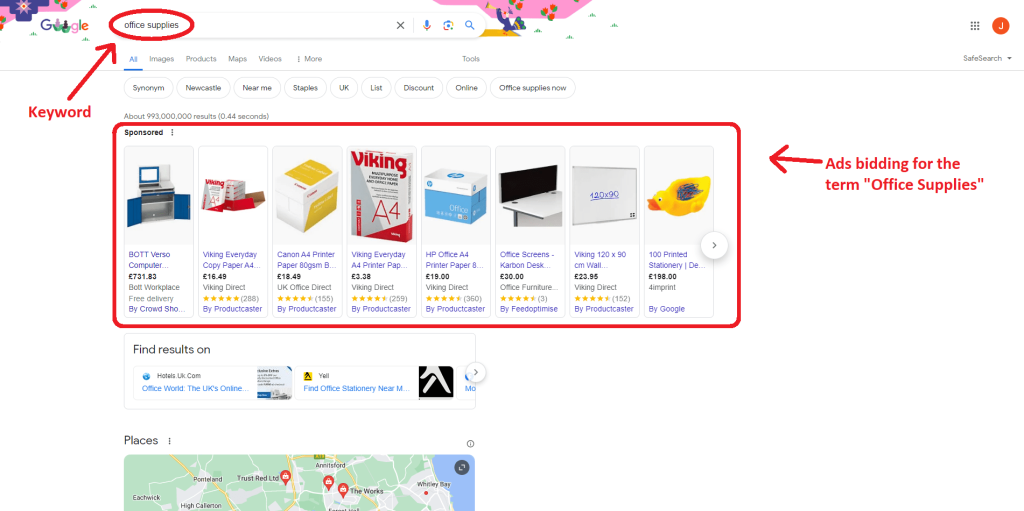
    As mentioned in the above section, an Ad Action is a bidding system. Advertisers must decide which terms they would like their ads to display for when a user makes a search. These terms are known as Keywords. Say, for example, that your business specializes in Office Supplies. A user looking to buy Printer Paper or Ink may enter the keyword “Office Supplies” into a search engine to find retailers offering these products.

    A Search Engine Results page highlighting the PPC results for the search term "office supplies".

    The moment a user submits a search query, the search engine performs a series of complex algorithmic calculations that the Ad Auction is based on. This determines which ads are displayed, in what order and by which advertiser.

    Since you pay for every click your ad receives, its important to only bit on keywords that are relevant to your products or services. Bidding on irrelevant keywords would produce a poor return on investment (ROI) for your Ad Campaign. Specialized keyword research allows you to bid on terms that are more likely to have a high ROI and produce a successful campaign for your business.

    Ready to take your visibility to the next level with Pay-Per-Click?

    Pay-Per-Click Advertising is an extremely powerful tool that can produce exceptional return on investment for businesses. PPC can be applied to almost any sector and can help provide instant results when compared to Organic search techniques.

    Here at Social+ our Paid Search Experts are here to help your business with its new or existing Ad Campaigns. With our dedicated Keyword research, Ad Copy creation, and Ad Optimization, we can help kickstart your paid search journey.

    Click here to find out more! Additionally, why not take a look at our socials to see what we’re about –  Facebook, Instagram, and LinkedIn.
  • Maximise ROI with PPC: Strategies for Successful Campaigns

    Maximise ROI with PPC: Strategies for Successful Campaigns

    Maximise ROI with PPC: Strategies for Successful Campaigns

    In the dynamic world of digital marketing, pay-per-click (PPC) advertising has emerged as a powerful tool for businesses looking to drive targeted traffic and achieve a strong return on investment (ROI).

    PPC offers the unique advantage of immediate visibility, measurable results, and precise audience targeting. However, to truly capitalise on its potential, businesses need to deploy effective strategies that can help maximise their ROI.

    In this blog, we will delve into the world of PPC and explore some proven strategies that can lead to a substantial boost in ROI.

    Understanding PPC and ROI

    Pay-Per-Click advertising entails placing ads on search engines and various other platforms; the business incurs a fee every time someone clicks their Ad.

    ROI, on the other hand, represents a critical metric that gauges the profitability of an investment. In the context of PPC, you calculate ROI by comparing the revenue generated from the PPC campaign to the total campaign cost.

    A positive ROI indicates that the campaign yields a profit, while a negative ROI indicates the need for adjustments to increase cost-effectiveness. These adjustments may involve modifying the keywords you bid on to reduce the cost per click

    So, what are some effective strategies to Maximise ROI with PPC?

    Thorough keyword research

    The foundation of any successful PPC campaign is comprehensive keyword research. Identifying keywords that are relevant to your business, products, or services is a key part of this. As a digital marketing agency we have access to specialist tools to help us find the best keywords for your campaign.

    Segmentation and Targeting

    Not all customers are the same. Create segmented ad groups that focus on specific demographics, geographic locations, or buying intentions. After creating groups we then tailor your ad copy and landing pages to resonate with each segment, increasing the likelihood of conversions. Segmenting your audience can be one of the most influential strategies you can adopt in both Digital marketing and PPC.

    Compelling Ad Copy

    Your ad copy needs to be engaging, concise, and convey the value proposition clearly. Highlight the benefits of your product or service and include a call-to-action (CTA) that prompts users to click through. A strong concise CTA is often more effective at engaging potential customers and can help you maximise ROI with PPC.

    Negative Keyword Management

    Regularly review and refine your list of negative keywords. These are keywords that trigger your ads but aren’t relevant to your business. By excluding irrelevant searches, you can save budget and ensure your ads are seen by the right audience. Regularly excluding negative keywords can help push your favoured ones increasing clickthrough.

    A/B Testing

    A/B testing refers to experimenting with two or more variants of your Ads which are shown to users at random. Statistical analysis is then used to determine which version performs better for a given goal. Continuously test different elements of your ads, such as headlines, ad copy, and CTAs. A/B testing allows you to identify what resonates best with your audience and refine your campaigns accordingly. This is an advanced technique that digital marketing firms such as ourselves would perform, it is time consuming but can be highly effective.

    Ready to get started on maximising your ROI with PPC

    Maximising ROI with PPC demands a strategic approach that combines thorough research, precise targeting, persuasive ad content, and continuous optimization.

    By implementing these strategies, your business can not only drive quality traffic but also attempt to maximise ROI with PPC campaigns.

    Setting up and managing an optimised Pay-Per-Click Advertising campaign can be a difficult task.

    Here at Social+, we design, research, create, and optimise PPC campaigns to help your business gain an edge over the competition.

    If you want to find out more about our PPC services click here or get in touch with us here!

    Additionally, why not take a look at our socials to see what we’re about – Facebook, Instagram, and LinkedIn.